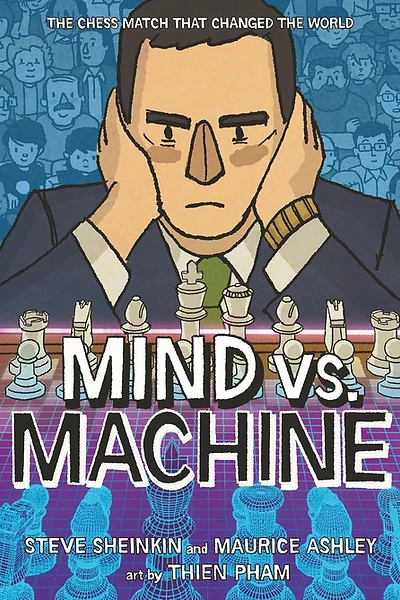
| Pace | The pace alternates between fast match tension and slower explanation of chess, computers, and strategy. |
| Plot | The plot follows a true contest:
human champion vs. machine challenger. |
| Prosody | Short panel text can sound sharp, tense, and dramatic. |
| Word pause | Graphic panels create built-in pauses between moves and reactions. |
| Concept | The central idea is human mind versus artificial intelligence. |
| Voice & World View | The voice treats chess as strategy, psychology, sport, and history. |
| Setting & Place | Settings include chessboards, match rooms, computer labs, and media attention. |
| Point of View | The book uses nonfiction narration with expert insight from chess grandmaster Maurice Ashley. |
| Original Characters | The people are real:
Garry Kasparov, IBM's team, Maurice Ashley, and Deep Blue's creators. |
| Dialogue | Dialogue and speech bubbles can create immediacy in the graphic format. |
| Details | Chess moves, computer history, match rules, and reactions make the story believable. |
| Descriptions | Description helps readers feel the silence, focus, and pressure of the match. |
| Strong First Lines | A strong opening can begin with the impossible question:
can a machine beat the best human mind? |
| Immediacy & Engagement | The match structure gives readers a reason to keep watching every move. |
| Story Scenes, Summaries & Unique Structures | The graphic novel blends scenes, history, explanation, and match-by-match pacing. |
| Flashback, Flash Forward & Cliffhangers | Background sections explain AI and chess history; game moments create cliffhangers. |
| Tension, Suspense & Surprise | Suspense comes from not knowing whether human intuition or machine calculation will win. |
| Page Turns and Chapter Breaks | Page turns can reveal a move, mistake, reaction, or result. |
| Performance | Panels invite dramatic reading through silence, reaction, and short lines. |
| Personality | Kasparov's confidence, intensity, and frustration can shape the pacing. |
| Humor | Humor can come from human reactions, chess culture, or tech confidence. |
| Pause | Pauses matter because chess is built on waiting and thinking. |
| Poetry and Poetic Devices | Contrast, repetition, and metaphor can turn chess into battle, music, or code. |
| Repetition | Repeated moves, clocks, turns, and calculations build rhythm. |
| Rhythm | The rhythm moves:
think, move, react, explain, turn page. |
| Punctuation | Ellipses, dashes, and exclamation points can control suspense and reaction. |
| Questions | The book raises questions about intelligence, creativity, machines, and the future. |
| Compare-Contrast | Human intuition contrasts with computer calculation. |
| Objects | Chessboard, pieces, clock, computer, screen, and notation carry meaning. |
| Threes | Three-part pacing can build pressure:
move, response, consequence. |
| Whitespace & Negative Space | Empty space can show silence, waiting, and mental pressure. |
| Art & Graphics | Thien Pham's graphic storytelling turns thinking into visible action. |
| Interactives & Gamification | The match naturally invites prediction and strategy. |