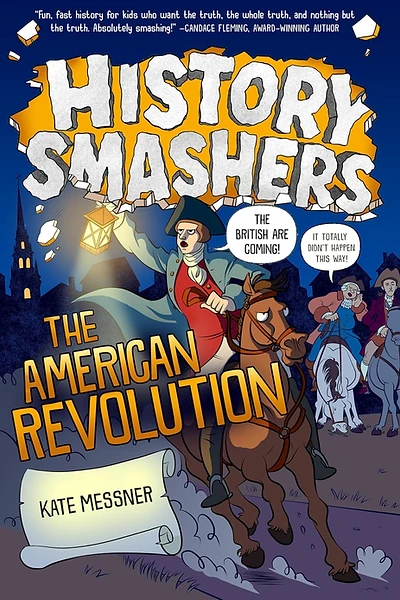
| Smash Alerts | Teach students to treat these as 'stop-and-think' points where the narrative interrupts itself to correct a bias. |
| Short Chapters | Encourage students to use these breaks to summarize the previous event before moving on. |
| Graphic Sidebars | Show students how to integrate these visual breaks without losing the flow of the main text. |
| Primary Source Insets | Guide students to pause the narrative flow to analyze the actual language of original documents. |
| Dialogue Bubbles | Use these to teach how historical characters speak and react, emphasizing personality over myth. |
| Humorous Annotations | Discuss how levity is used to keep the reader's pace from stalling during heavy historical details. |
| Maps and Diagrams | Direct students to trace spatial relationships between battlefields to visualize the war's scope. |
| Vocabulary Pop-ups | Highlight these as speed-bumps for understanding context-specific terminology. |
| Narrative Asides | Point out how these break the fourth wall, keeping the reader connected to the author's voice. |
| Timeline Intervals | Teach students to use these to pace their mental reconstruction of sequential events. |
| Chapter Headings | Ask students to predict the focus before reading, helping them manage their expectations of speed. |
| Illustrative Metaphors | Analyze how art helps explain complex political motives without slowing down the read. |
| Sidebar Quotes | Explain that these function as pauses for reflection on primary source perspectives. |
| Question Prompts | Use these to regulate pacing by forcing a stop for self-inquiry. |
| Biography Snippets | Treat these as rhythmic deviations that provide human context for the war. |
| Comparison Tables | Guide readers to slow down when analyzing data points across multiple columns. |
| Author Notes | Teach these as end-of-section reflections on the research process. |
| Iconography | Use icons to help students scan for specific types of information at different speeds. |
| Humor Shifts | Monitor how the reader's emotional pacing fluctuates with the author's dry wit. |
| Historical Myths | Identify these as central anchors that slow down the narrative to allow for debunking. |
| Call-out Boxes | Use these as high-intensity, short-duration information bursts. |
| Action Sequences | Highlight how sentence structure becomes faster when describing military maneuvers. |
| Political Context Blocks | Instruct students to read these slower to ensure comprehension of complex motivation. |
| Diverse Perspective Insets | Emphasize these as deliberate rhythm changes to include underrepresented voices. |
| Document Analysis | Show how slowing down here rewards the reader with deeper understanding. |
| Checkpoints | Encourage students to use these for self-monitoring their own pacing. |
| Character Sketches | Use these to provide depth to fast-moving historical events. |
| Myth-vs-Fact Tables | Teach students to compare these horizontally to speed up data synthesis. |
| Footnotes | Explain that these are optional deep-dives that change the reading pace. |
| Concluding Summaries | Use these to wrap up the narrative velocity at the end of every chapter. |
| Visual Pacing | Observe how the layout designs force the eye to move in non-linear ways. |
| Interactive Questions | Force a pause to connect past events to modern life. |
| Concluding Reflection | Slow the reader down to synthesize the chapter's main argument. |